Program case study · FIT, 2006 to 2013 · Redesign, 2026
PrintHaus
Then: the $30K print shop. Now: the system it should have become.
Interactive demo Run the PrintHaus demoThe operation
From 2006 to 2013 I ran day-to-day operations at PrintFX, the FIT Library's digital print bureau. Ordering ran on paper forms clipped to USB sticks, sorted into piles on the counter. A whiteboard tracked who was on which printer. Finished jobs went to a QC table, where a different worker checked them before the customer was called. It worked, and it was capped: about $30,000 a year, every step depending on someone's hands, and no way for a student to see their own job.
Before changing anything, I asked what customers were actually complaining about. It was not print quality. It was the ordering: confusing forms, lost orders, no visibility into when a job would be done. Staff had the mirror problem: no training standard, everyone doing it differently.
In 2006, my first year, we digitized the paper forms into fillable PDFs. The first month showed the old forms were the problem, so I hired a dedicated graphic designer to redo them from scratch, and we tested each version with students filling them out while we watched. The forms had two users, the student and the worker reading them as print instructions, and both had to be served. My manager's paper trail was her audit system, so the digital forms carried the same accountability, not just more speed.
Demand came through faculty. I went to the department chairs and got instructors requiring students to print their projects at the bureau, priced at cost so the money stayed in the school. Then I worked the cost base: ink was the biggest cost, so I negotiated vendor pricing on ink, supplies, and paper down. Revenue grew from about $30,000 to $160,000 a year over several years, and the extra funds went back to the school, which let the IT department buy equipment it needed.
The FabLab came from the same habit of looking. The Toy Design program had about $100,000 for 3D printing and no space or staff to run it. I got the departments that needed prototyping to pool their budgets and built a shared shop, open to the whole school, that no one department could have afforded alone. When I arrived the department was GraphicsLab-PrintFX. When I left in 2013 it was PrintFX/FabLab.
The floor ran on a model I had picked up volunteering in friends' restaurant kitchens: production is the back of the house, the counter is the front, and the order form is a ticket that carries the customer's need between them. One attempt to buy the software version fell short. FIT's food-systems vendors adapted their ordering platform for us, and it failed on structure: a burger is standardized, and a print job is a file, a stock, a size, a finish, and a deadline, all variable. We kept the digitized forms. The system behind them stayed in my head.
The build, run as a program
In 2026 I directed that system's build, as a concept, to finish what the 2006 project started. PrintFX did not commission it, and FIT does not endorse or operate it. I ran it like a client engagement anyway: a written brief, then product requirements, technical requirements, an app flow, a design brief, a data model, and an implementation plan, with the same names for the same things across all six documents. Decisions went into a log as I ruled on them, and the log closed with nothing left open and nothing filled in silently.
The plan split the product by role, not screen size: customers order from a phone app, staff run production from workstations, the status board is a wall surface, and one store of record sits under all three. Accessibility requirements went into the brief as acceptance criteria: status never carried by color alone, errors in plain language, every interface string in one table so a second language is a translation job, and a page-weight budget for a low-end phone on a slow connection.
Quality gates ran on the built software, not on the documents. The first full iteration tested correct against its specification and still read, on screen, as a new palette over the wrong structure, so the next iteration was built from scratch, carrying over the service catalog and nothing else. Two standing rules came out of that iteration: a brief says from scratch in so many words when from scratch is what is meant, and a design system is judged on rendered screens, not on a diff of its values.
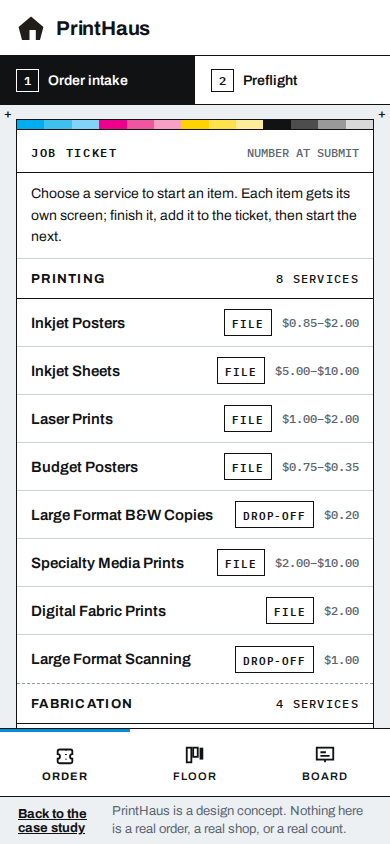
Testing the app drove the next iteration. The first intake kept the whole catalog on screen while one service was configured. It now works one item at a time: pick a service, the screen becomes that item, finish it onto the ticket, then add another or submit. The catalog also got sorted by what the customer hands over. Ten services take a file. Six take a physical object, which enters production when the counter receives it. Design Services takes the designer's time, booked in 60-minute blocks. That shape came from checking the source instead of assuming: a draft offered 30-minute consultations, and the retrieved Fall 2026 Design Order form offers no consultations at all. It prices design at $35 an hour with a two-day lead, and the booking now runs on the form's terms.
The same discipline runs under the hood. Supplies post to a ledger at set points in a job's life. The analytics screen's totals are recomputed independently from the order and posting records by a test suite that fails the build when the screen and the sums disagree. The demo stands at 179 automated checks, zero failures. The version linked below is the final iteration.
Directing the design
The identity got the same treatment as the software. Eighteen candidate marks were drawn, rendered at the 32 and 16 pixel sizes they would actually live at, and judged on measurements anyone can re-run: pixel counts, contrast ratios, channel widths at favicon size. A confident outside review picked an early winner on claims about small-size rendering. The renders showed two of its claims wrong, and it conceded. I picked a mark I had drawn myself, a house form with its door offset from center, over measured recommendations that scored better on parts of the evidence, and the record keeps what I passed over and why.